
Nuclear-Lab was created to document practical aspects of radiation detection electronics and measurement systems based on scintillation detectors.
Most publicly available materials in this field fall into two categories:
- highly theoretical scientific publications,
- product descriptions with limited technical depth.
There is very little openly accessible content showing how complete measurement systems are actually designed, stabilized, integrated and deployed outside controlled laboratory environments.
Nuclear-Lab aims to fill that gap.
What will be published here?
The blog will focus on practical engineering topics, including:
- digital pulse processing (DPP) techniques,
- high count-rate signal acquisition,
- baseline stabilization and drift compensation,
- pile-up detection strategies,
- time-correlated measurements,
- integration of PMT and SiPM detectors,
- FPGA-based data acquisition architectures,
- standalone radiation measurement systems,
- examples of real spectral measurements,
- system integration workflows for field applications.
Where possible, posts will include measurement examples, configuration notes, screenshots and implementation considerations.
The goal is not to disclose proprietary solutions, but to provide technically meaningful insight into how modern radiation detection systems can be built and deployed.
Application-oriented focus
Nuclear-Lab is also intended as a technical resource for system integrators.
Many engineering teams are capable of building complete radiation detection solutions, but the bottleneck is often the time required to develop stable, high-performance signal acquisition electronics from scratch.
The blog will therefore demonstrate:
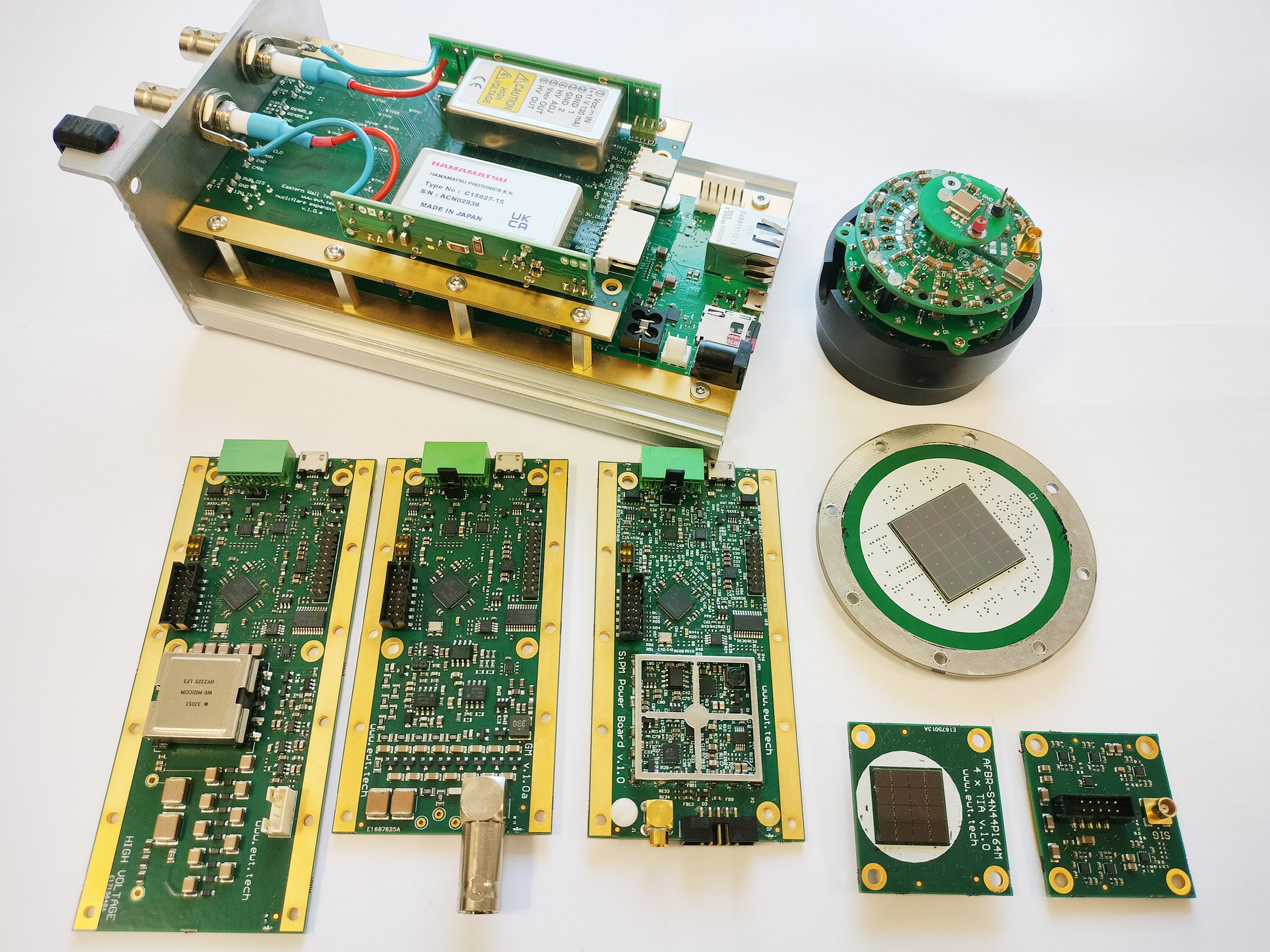
- how modular radiation detection components can be combined into complete systems,
- how to integrate digitizers, high-voltage supplies and detector front-ends,
- how to configure standalone measurement platforms,
- how to build application-specific solutions based on ready-to-integrate hardware.
The objective is simple:
to shorten the path from research instrumentation to deployable systems.
Who is this for?
This blog is primarily intended for:
- engineers integrating radiation detection into larger systems,
- companies building application-specific monitoring platforms,
- researchers transitioning from laboratory setups to field-oriented devices,
- developers working on gamma and neutron detection technologies.
Why it matters
In many projects, the limiting factor is not detector physics, but the time required to transform laboratory instrumentation into a stable, field-ready platform.
Nuclear-Lab will document practical solutions to that challenge.
If you are developing radiation detection systems and looking for robust, application-oriented building blocks, this blog is for you.

0 Comments